


As a supplier of PV system batteries, I often get asked about the reaction mechanism of these crucial energy storage components. Understanding how PV system batteries work at a chemical level is essential for anyone involved in solar energy systems, from installers to end - users. In this blog, I'll delve into the reaction mechanisms of different types of PV system batteries.
Lead - acid Batteries
Lead - acid batteries are one of the most common types used in PV systems. They have been around for a long time and are known for their reliability and relatively low cost.
The basic structure of a lead - acid battery consists of a positive electrode (lead dioxide, (PbO_{2})), a negative electrode (spongy lead, (Pb)), and an electrolyte solution of sulfuric acid ((H_{2}SO_{4})).
Discharge Reaction
When the lead - acid battery is discharging, a series of chemical reactions occur. At the negative electrode, lead ((Pb)) reacts with sulfate ions ((SO_{4}^{2 -})) from the sulfuric acid electrolyte. The half - reaction at the negative electrode is:
[Pb(s)+SO_{4}^{2 -}(aq)\to PbSO_{4}(s)+2e^{-}]
This reaction releases electrons, which flow through the external circuit to power the load.
At the positive electrode, lead dioxide ((PbO_{2})) reacts with hydrogen ions ((H^{+})) and sulfate ions ((SO_{4}^{2 -})) from the electrolyte, along with the electrons coming from the negative electrode. The half - reaction at the positive electrode is:
[PbO_{2}(s)+4H^{+}(aq)+SO_{4}^{2 -}(aq)+2e^{-}\to PbSO_{4}(s)+2H_{2}O(l)]
The overall discharge reaction of the lead - acid battery is the sum of these two half - reactions:
[Pb(s)+PbO_{2}(s)+2H_{2}SO_{4}(aq)\to 2PbSO_{4}(s)+2H_{2}O(l)]
During the discharge process, the sulfuric acid in the electrolyte is consumed, and the density of the electrolyte decreases. This decrease in electrolyte density can be used as an indicator of the state of charge of the battery.
Charge Reaction
When the lead - acid battery is being charged, the reverse reactions occur. At the negative electrode, electrons are forced into the electrode by the charging source. The lead sulfate ((PbSO_{4})) on the negative electrode reacts with the electrons and hydrogen ions ((H^{+})) from the electrolyte to form lead ((Pb)) and sulfuric acid. The half - reaction at the negative electrode is:
[PbSO_{4}(s)+2e^{-}\to Pb(s)+SO_{4}^{2 -}(aq)]
At the positive electrode, lead sulfate ((PbSO_{4})) reacts with water ((H_{2}O)) to form lead dioxide ((PbO_{2})), hydrogen ions ((H^{+})), and sulfate ions ((SO_{4}^{2 -})). The half - reaction at the positive electrode is:
[PbSO_{4}(s)+2H_{2}O(l)\to PbO_{2}(s)+4H^{+}(aq)+SO_{4}^{2 -}(aq)+2e^{-}]
The overall charge reaction is:
[2PbSO_{4}(s)+2H_{2}O(l)\to Pb(s)+PbO_{2}(s)+2H_{2}SO_{4}(aq)]
As the battery charges, the sulfuric acid concentration in the electrolyte increases, and the density of the electrolyte rises back to its original value.
If you are interested in high - quality lead - acid batteries for your PV system, you can check out our Lead - acid Battery product page.
Gel Batteries
Gel batteries are a type of valve - regulated lead - acid (VRLA) battery. They use a gel - type electrolyte instead of a liquid electrolyte like traditional lead - acid batteries.
The reaction mechanism of gel batteries is similar to that of traditional lead - acid batteries. The main difference lies in the physical state of the electrolyte. In gel batteries, the sulfuric acid electrolyte is mixed with silica fume to form a gel. This gel immobilizes the electrolyte, which has several advantages.
Advantages of Gel Batteries in PV Systems
- Reduced risk of leakage: Since the electrolyte is in a gel state, there is a lower risk of electrolyte leakage, which is especially important in PV systems where the batteries may be installed in various locations, including indoors.
- Deep - discharge tolerance: Gel batteries can withstand deeper discharges compared to some other types of batteries without significant damage. This makes them suitable for PV systems where the battery may experience partial state - of - charge conditions.
The chemical reactions during charging and discharging are the same as in lead - acid batteries. During discharge, lead and lead dioxide react with the sulfate ions in the gel electrolyte to form lead sulfate, and during charging, the lead sulfate is converted back to lead and lead dioxide.
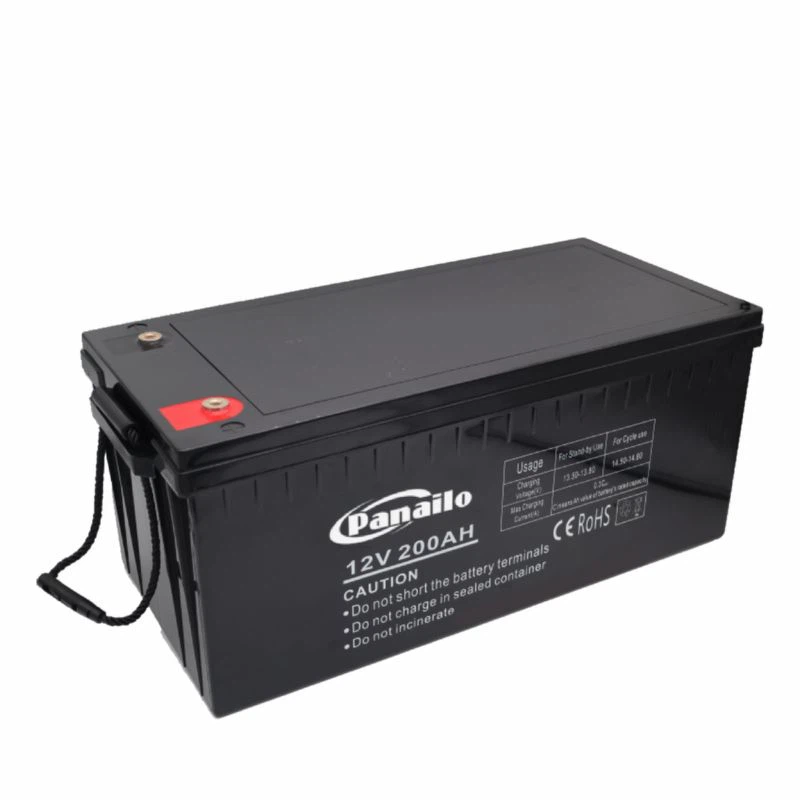
If you are looking for a Gel Battery for Pv System, we have a range of products to meet your needs. For example, our 200ah - 12v Gel Battery for Solar System is a popular choice among PV system installers.
Lithium - ion Batteries
Lithium - ion batteries are becoming increasingly popular in PV systems due to their high energy density, long cycle life, and low self - discharge rate.
The basic structure of a lithium - ion battery consists of a positive electrode (usually a lithium metal oxide, such as lithium cobalt oxide (LiCoO_{2})), a negative electrode (usually graphite), and a lithium - containing electrolyte.
Discharge Reaction
During discharge, lithium ions ((Li^{+})) in the positive electrode material migrate through the electrolyte to the negative electrode. At the negative electrode, the lithium ions intercalate into the graphite structure. The half - reaction at the negative electrode is:
[C_{6}+xLi^{+}+xe^{-}\to Li_{x}C_{6}]
At the positive electrode, the lithium metal oxide releases lithium ions and electrons. For example, in a lithium cobalt oxide ((LiCoO_{2})) positive electrode, the half - reaction is:
[LiCoO_{2}\to Li_{1 - x}CoO_{2}+xLi^{+}+xe^{-}]
The overall discharge reaction is the combination of these two half - reactions, which results in the flow of electrons through the external circuit to power the load.
Charge Reaction
When the lithium - ion battery is charged, the reverse process occurs. Lithium ions are forced from the negative electrode (graphite) back to the positive electrode (lithium metal oxide). The charging process requires an external power source to provide the energy to drive these reactions.
Factors Affecting Battery Reaction Mechanisms in PV Systems
- Temperature: Temperature has a significant impact on the reaction rates in batteries. In general, higher temperatures increase the reaction rates, but they can also accelerate battery aging. For example, in lead - acid batteries, high temperatures can cause the electrolyte to evaporate more quickly and can lead to the formation of internal shorts.
- State of Charge: The state of charge of the battery affects the chemical reactions. Over - charging or over - discharging can cause irreversible damage to the battery electrodes. For instance, in lead - acid batteries, over - charging can lead to the generation of hydrogen and oxygen gases, which can cause water loss and damage to the battery.
- Charging and Discharging Rates: High charging or discharging rates can also affect the battery's performance. Fast charging or discharging can cause uneven distribution of reactants within the battery, leading to reduced battery life.
Conclusion
Understanding the reaction mechanisms of PV system batteries is crucial for optimizing the performance and lifespan of these energy storage devices. Whether you choose lead - acid, gel, or lithium - ion batteries, each type has its own unique reaction characteristics and requirements.
As a PV system battery supplier, we are committed to providing high - quality batteries that meet the specific needs of your solar energy system. If you have any questions about our products or need help in selecting the right battery for your PV system, please don't hesitate to contact us for a procurement discussion. We look forward to working with you to ensure the success of your PV project.

References
- Linden, D., & Reddy, T. B. (2002). Handbook of Batteries. McGraw - Hill.
- Tarascon, J. M., & Armand, M. (2001). Issues and challenges facing rechargeable lithium batteries. Nature, 414(6861), 359 - 367.