


As a supplier of Telecom Pole with Ladder, I'm excited to share with you the essential safety features of these crucial structures. Telecom poles with ladders play a vital role in the telecommunications industry, providing access to equipment and facilitating maintenance and repairs at height. Ensuring the safety of workers who climb these poles is of utmost importance, and that's why our products are designed with a comprehensive range of safety features.
Structural Integrity
The foundation of safety in a telecom pole with a ladder lies in its structural integrity. Our poles are engineered to withstand various environmental conditions and loads, ensuring they remain stable and secure over time. We use high - quality steel materials that are carefully selected for their strength and durability. The poles are designed to resist corrosion, which can weaken the structure over time. For instance, our Hot - dip Galvanized and Powder Coated Telecom Pole undergoes a hot - dip galvanizing process, which provides a protective zinc coating that prevents rust and corrosion. This not only extends the lifespan of the pole but also maintains its structural strength, reducing the risk of collapse or failure.
The design of the pole also takes into account the weight of the equipment it will support, as well as the forces exerted by wind, ice, and other environmental factors. Our engineers use advanced computer - aided design (CAD) software to model different scenarios and ensure that the pole can handle the expected loads safely. Additionally, the poles are tested rigorously in accordance with industry standards to verify their structural integrity before they are deployed in the field.
Ladder Design
The ladder is a critical component of a telecom pole, as it provides the means for workers to access the equipment at height. Our ladders are designed with safety as the top priority. First, the rungs of the ladder are made of high - strength materials that can support the weight of a worker and any tools or equipment they may be carrying. The spacing between the rungs is carefully calculated to ensure that it is comfortable and safe for workers to climb. A proper rung spacing allows for a natural and stable climbing motion, reducing the risk of slips and falls.

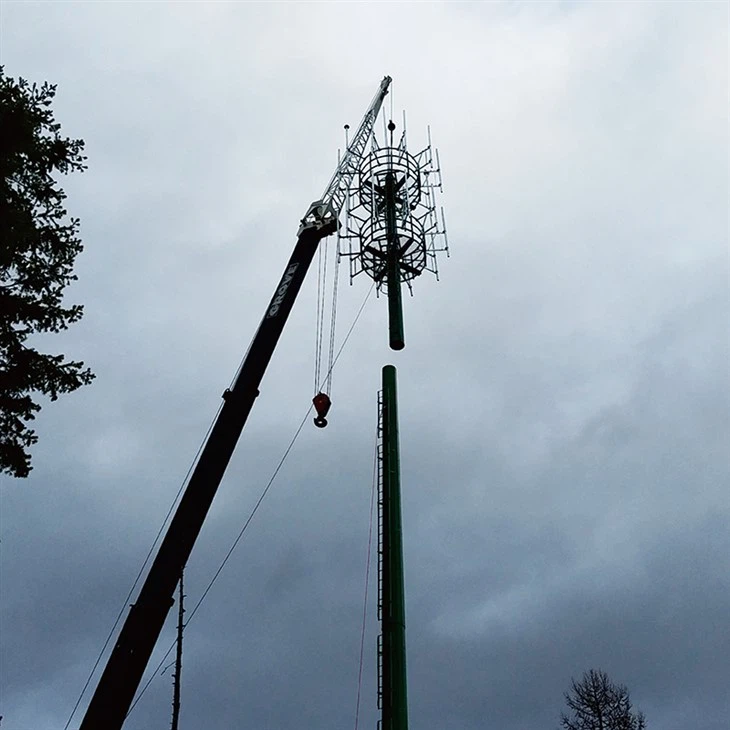
The ladder is also equipped with anti - slip surfaces on the rungs. This is especially important in wet or icy conditions, as it provides additional traction and grip for the worker's feet. The anti - slip coating is designed to withstand the wear and tear of regular use and exposure to the elements. In addition, the ladder is securely attached to the pole to prevent it from shifting or becoming loose during climbing. We use high - quality fasteners and brackets that are designed to withstand the forces exerted during climbing and ensure a stable connection between the ladder and the pole.
Fall Protection
Fall protection is a key safety feature of our telecom poles with ladders. We understand that working at height is inherently dangerous, and that's why we provide a range of fall protection systems. One of the most common fall protection systems we offer is a safety harness and lanyard. Workers are required to wear a properly fitted safety harness that is attached to a secure anchor point on the pole. The lanyard provides a connection between the harness and the anchor point, limiting the distance a worker can fall in case of an accident.
In addition to the safety harness and lanyard, we also install fall arrest systems on our poles. These systems are designed to stop a worker's fall before they reach the ground. Fall arrest systems typically consist of a shock - absorbing lanyard and an anchor point that is designed to withstand the impact of a falling worker. The shock - absorbing lanyard reduces the force of the fall on the worker's body, minimizing the risk of injury.
Handrails and Guardrails
To provide additional support and safety for workers, our telecom poles with ladders are often equipped with handrails and guardrails. Handrails are installed along the sides of the ladder to give workers something to hold onto while climbing. They provide a stable and secure grip, which can help prevent slips and falls. The handrails are made of strong materials and are designed to withstand the forces exerted by a worker's grip.
Guardrails are installed at the top of the pole or at platforms where workers may need to stand or work. They act as a physical barrier to prevent workers from accidentally falling off the edge of the pole or platform. The guardrails are typically made of metal and are designed to be strong enough to withstand the impact of a worker leaning against them or accidentally colliding with them.
Visibility and Markings
Visibility is an important safety consideration for telecom poles with ladders. Our poles are marked with clear and visible signs to indicate their purpose, height, and any safety precautions. Reflective markings are also applied to the pole and the ladder to make them more visible at night or in low - light conditions. This helps to prevent accidents by making the pole more noticeable to workers, as well as to other people in the area, such as motorists or pedestrians.
In addition, the poles are color - coded to indicate different levels of access or safety zones. For example, a certain color may be used to mark the area where workers are required to wear fall protection equipment. This visual cue helps workers to quickly and easily identify the safety requirements in different areas of the pole.
Maintenance and Inspection
Regular maintenance and inspection are essential for ensuring the continued safety of a telecom pole with a ladder. We provide detailed maintenance guidelines to our customers, which include instructions on how to inspect the pole and the ladder for signs of damage or wear. Our poles are designed to be easy to maintain, with accessible components that can be inspected and replaced as needed.
Inspections should be carried out at regular intervals, and any issues or defects should be addressed immediately. This may involve replacing damaged rungs on the ladder, repairing a loose connection between the ladder and the pole, or repainting the anti - slip surfaces. By conducting regular maintenance and inspections, we can ensure that the safety features of the pole remain in good working condition, reducing the risk of accidents and injuries.
Conclusion
In conclusion, our Telecom Pole with Ladder is designed with a comprehensive range of safety features to protect the workers who use them. From the structural integrity of the pole to the fall protection systems and ladder design, every aspect of our product is carefully engineered to ensure safety. We are committed to providing high - quality poles that meet or exceed industry standards and provide a safe working environment for telecom workers.
If you are in the market for a reliable and safe Telecom Pole with Ladder, we invite you to explore our product range. Our 31m Telecom Pole and Telecom Pole with Ladder are just some of the options available to you. Contact us today to discuss your specific requirements and start a procurement discussion. We look forward to working with you to provide the best telecom pole solutions for your needs.
References
- Telecommunications Industry Association (TIA) standards for telecom poles.
- Occupational Safety and Health Administration (OSHA) regulations for working at height.
- American National Standards Institute (ANSI) standards for ladder design and safety.